


 What are colored pencils? What are colored pencils?Contrary to what most people think, there are many different types and qualities of colored pencils. The differences are noticeable in hardness and color fastness. This difference is usually brand-dependent. Some manufacturers produce 2 collections of colored pencils. One collection is often softer with thicker leads, making them suitable for filling areas and creating beautiful color blends and transitions. The other collection is usually harder, allowing for precise detailing, with typically thinner leads. |
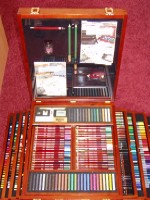
| In addition to traditional pencils with a wooden casing, there are also pencil-shaped sticks available, similar to sketch and drawing pencils. These are produced from a kind of clay mixed with pigment and pressed into pencil form. Most manufacturers offer around 75-100 colors per collection in their range. Good quality brand pencils are available individually. Here you see a collection with various drawing materials, all from the Derwent brand.. |
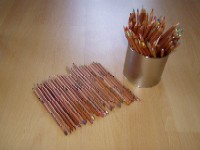 Combining Colored Pencils Combining Colored PencilsNormal or "wax" pencils can be combined with various other materials. The most common combinations are those of colored pencils with pastel or watercolor pencils. With colored pencils, unlike pastel pencils, you work from light to dark. |
| Additional articles: SSpecial tips on various types of colored pencils can be found in the articles:
|
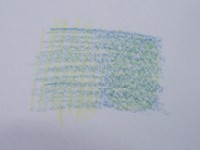 Blending with wax-based pencils; wax-based pencils come in different hardnesses. Especially the harder pencils are difficult to blend. Therefore, you blend them by hatching or glazing. Blending with wax-based pencils; wax-based pencils come in different hardnesses. Especially the harder pencils are difficult to blend. Therefore, you blend them by hatching or glazing. |
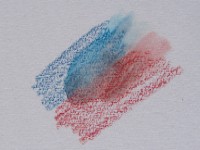 Turpentine and wax-based pencils; wax-based pencils are not soluble in water, but they are soluble in, for example, turpentine. Depending on the stiffness of the brush used to apply the turpentine, you can achieve different effects. Here, Sansodor has been used. This is a synthetic material, less harmful than turpentine, from the Winsor & Newton brand. Turpentine and wax-based pencils; wax-based pencils are not soluble in water, but they are soluble in, for example, turpentine. Depending on the stiffness of the brush used to apply the turpentine, you can achieve different effects. Here, Sansodor has been used. This is a synthetic material, less harmful than turpentine, from the Winsor & Newton brand. |
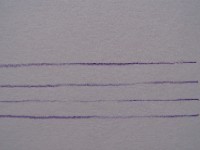  Hard lines with a pencil; the harder wax-based pencils are excellent for details and crisp lines. You see lines made with a hard pencil in the left image. You cannot vary the line thickness much by pressing harder. Soft contours with soft pencils; if you want softer lines that vary more in thickness depending on the pressure you exert, you should choose softer pencils. An example of this is shown in the right image. You can vary the line thickness considerably by pressing harder or softer while drawing. Hard lines with a pencil; the harder wax-based pencils are excellent for details and crisp lines. You see lines made with a hard pencil in the left image. You cannot vary the line thickness much by pressing harder. Soft contours with soft pencils; if you want softer lines that vary more in thickness depending on the pressure you exert, you should choose softer pencils. An example of this is shown in the right image. You can vary the line thickness considerably by pressing harder or softer while drawing. |
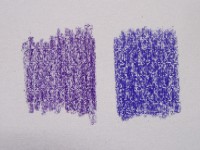 Coloring; softer pencils color more evenly and also give off more pigment than harder colored pencils. The left patch was drawn with a harder pencil. Here you can still see distinct streaks. The right patch was drawn with a soft pencil brand, and this patch is more even and deeper in color. Coloring; softer pencils color more evenly and also give off more pigment than harder colored pencils. The left patch was drawn with a harder pencil. Here you can still see distinct streaks. The right patch was drawn with a soft pencil brand, and this patch is more even and deeper in color. |
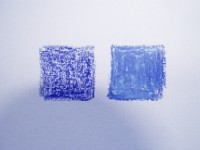 Polishing or burnishing with a white or light pencil; by going over a color area with a white or light-colored pencil with reasonable pressure, you can polish the color. The color becomes lighter, and the whole seems to shine. You can also polish with other colors. This creates a mixed color. Polishing or burnishing with a white or light pencil; by going over a color area with a white or light-colored pencil with reasonable pressure, you can polish the color. The color becomes lighter, and the whole seems to shine. You can also polish with other colors. This creates a mixed color. |
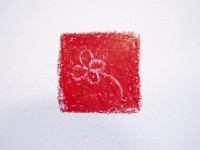 Sgraffito with a knife; especially with thicker layers of color, the sgraffito technique works well. Sgraffito refers to scratching lines with a knife through the pigment layer. You can create a thicker color layer most easily with soft colored pencils. Sgraffito with a knife; especially with thicker layers of color, the sgraffito technique works well. Sgraffito refers to scratching lines with a knife through the pigment layer. You can create a thicker color layer most easily with soft colored pencils. |
| Substrates for Colored Pencils: Generally, pencils are used in combination with paper. However, it is possible to work with pencils on surfaces treated with gesso, for example. The types of paper used often depend on the material with which the pencils are combined. If a combination with wet techniques like watercolor pencils is used, generally stretched watercolor paper is used. Paper of at least 300 gsm or watercolor board does not need to be stretched. If pencils are used in combination with pastel pencils, colored pastel paper is often used. The possibilities are numerous and present a challenge for those who want to experiment. |
Storing and Protecting Artwork:
|